Two brands pay the same creator $2,000 and get completely different deals. One bought a single post. The other bought a base fee plus a share of the sales it drives. The number on the invoice is identical; the pricing model underneath it is not — and the model decides far more than the rate does.
The model sets who carries the risk, what you can renegotiate next time, and — most often overlooked — whether you will be able to tell afterwards whether the campaign worked. This guide walks through the models brands actually use in 2026, the ranges each one runs in, and what each quietly hides. If you are earlier in the process and still asking what sets a creator’s rate in the first place, start with our influencer price list guide.
1. Flat fee per post
The default. You agree on a fixed amount for an agreed deliverable: one Reel, three Stories, a YouTube integration.
Rough 2026 bands, per post, USD:
- Nano (1K–10K): $10 – $100
- Micro (10K–100K): $100 – $500
- Mid-tier (100K–500K): $500 – $2,500
- Macro (500K–1M): $2,500 – $10,000+
- Mega (1M+): $10,000 – $100,000+
When it fits: awareness campaigns, first-time collaborations, anything where you need cost certainty before you start.
What it hides: everything about performance. A flat fee is priced on follower count — the single worst predictor of what a post will actually do. You find out what you bought after you have paid for it.
2. CPM — cost per thousand impressions
You pay per thousand people reached. Typical creator-partnership CPM runs $5 – $15 per 1,000 impressions on Instagram and YouTube, with the broader market spanning roughly $2 – $15 depending on platform, format and audience quality.
CPM is the model borrowed most directly from paid media, which is exactly its appeal and its weakness: it makes an influencer look like an ad placement.
When it fits: reach-led campaigns, and comparing influencer spend against the paid social budget it competes with internally.
What it hides: impressions are not attention. A Story seen for half a second and a Reel watched three times both count as one impression. CPM also rewards large accounts by construction — reach is the one thing they are guaranteed to have.
3. CPE — cost per engagement
You pay per interaction: a like, a comment, a save, a share. This looks like the honest model — you are paying for reaction rather than for reach.
Then you go looking for a benchmark and find that published CPE figures disagree by an order of magnitude. Depending on the source, a “normal” CPE is anywhere from $0.05 to $5.00 per engagement.
That spread is not sloppy research. It is the model’s actual flaw showing through: nobody agrees on what counts as an engagement.
- Does a save count? A share? On TikTok, when we measured ad-labelled content in Turkey, shares and saves together made up 20.7% of all engagement. Count them or don’t and the same video’s engagement moves by a fifth.
- Does a one-emoji comment count the same as “where can I buy this”? Under CPE, yes. They are billed identically.
- Does a like from a bought follower count? Under CPE, also yes.
So CPE prices volume of reaction while pretending to price quality of reaction. It is a better model than CPM, but only if you define the numerator in the contract — and then verify it.
When it fits: community-building and consideration campaigns, where the interaction itself is the point.
What it hides: the difference between an audience that is engaged and an audience that is merely active. That gap is where most influencer budget quietly goes; we walk through it in what engagement rate actually tells you.
4. Affiliate and commission
The creator earns a percentage of the sales their link or code produces. Commission rates commonly sit between 5% and 30%, clustering by category: e-commerce around 5–15%, fashion and beauty 10–20%, subscriptions 10–25%, software 15–30%.
When it fits: direct-response products with a short purchase path, and creators who already sell to their audience rather than just entertain it.
What it hides: two things. First, established creators increasingly decline commission-only deals — the risk sits entirely with them, and they know their rate. Second, attribution. A follower who sees the post, thinks about it for a week and then searches for your brand directly shows up nowhere in the affiliate report. Commission-only pricing systematically underpays the top of the funnel and then concludes the top of the funnel doesn’t work.
5. Gifting and product-only
You send product; no cash changes hands. Realistically this works with nano creators, genuinely relevant niches, and products with a high enough perceived value to be worth someone’s production time.
What it hides: the cost. Gifting is not free — it costs product margin, shipping, coordination time, and a lower and less predictable output rate, because nothing contractually obliges anyone to post. Note also that gifted content is still commercial content: disclosure obligations apply exactly as they do to paid posts.
6. Hybrid — base fee plus performance
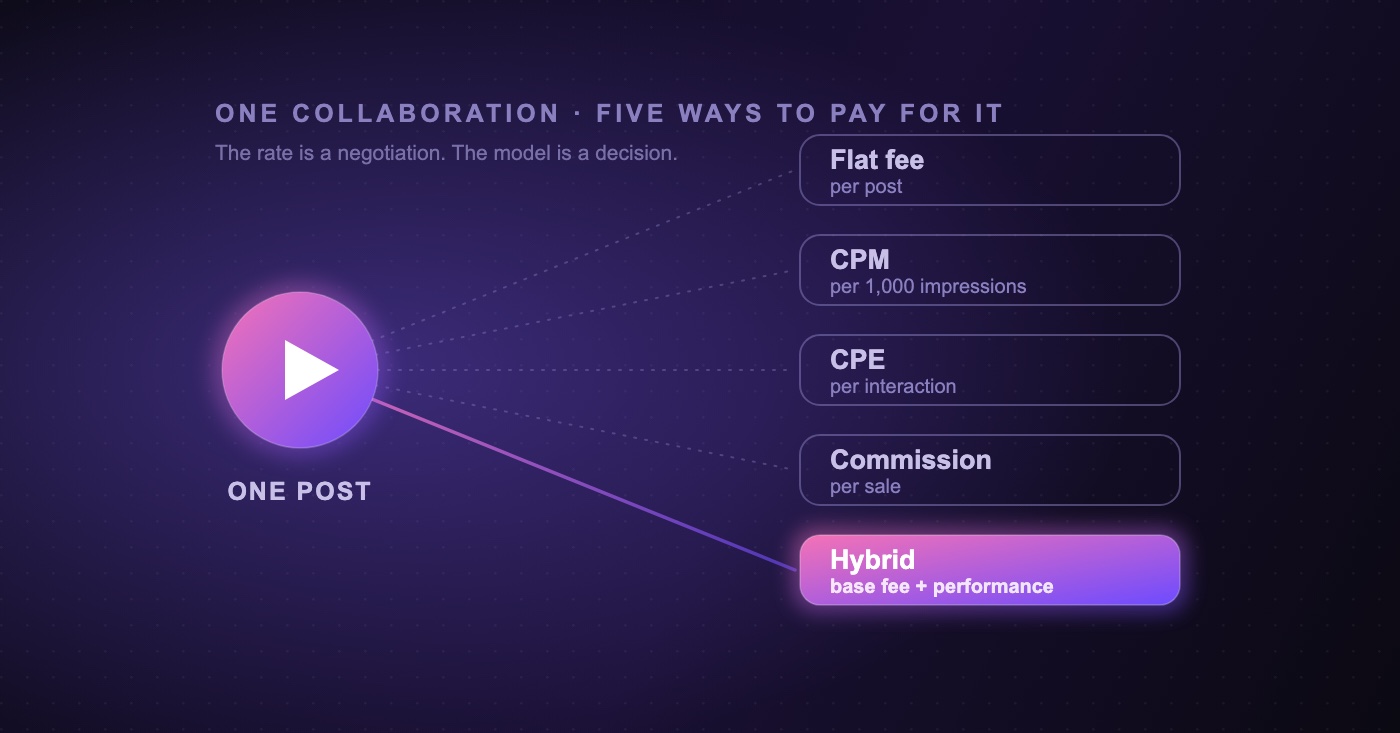
Increasingly the default for anything serious in 2026: a reduced flat fee that guarantees the creator’s production cost, plus a performance component on top — commission, a CPM top-up, or a bonus at an agreed threshold.
A worked example: $2,000 base, plus $8 per 1,000 impressions above a floor, plus a bonus per conversion.
When it fits: almost everywhere, once both sides have worked together before or trust the measurement.
What it hides: nothing structural — but it only works if the performance half is measured on something both sides accept in advance. Hybrid deals fail in the reconciliation conversation, not in the campaign.
7. Retainer
A monthly fee for ongoing content — roughly $3,000 – $10,000 per month for consistent output from an established creator. Growing quickly, because repetition beats reach: the third time an audience sees a creator use your product is worth more than the first.
When it fits: always-on brand presence, and ambassador programmes.
What it hides: drift. Month four’s content is rarely as sharp as month one’s, and the retainer keeps paying either way unless something is reviewing the output.
Which model for which objective
| Objective | Model that fits | Why |
|---|---|---|
| Awareness / launch | Flat fee or CPM | Cost certainty, reach is the deliverable |
| Consideration | CPE or hybrid | You want reaction, not just delivery |
| Direct sales | Affiliate or hybrid | Pays for the outcome |
| Long-term presence | Retainer | Repetition compounds |
| Testing a new creator | Flat fee, one post | Cheapest way to buy information |
The part every performance model depends on
Notice that four of these models — CPM, CPE, affiliate, hybrid — all end in the same place. They price a number: impressions, engagements, conversions. Which means the entire deal rests on whether that number represents real people having a real reaction.
That is not a contractual problem; it is a measurement problem. A creator with bought engagement is not more expensive under CPE — they are cheaper, because the inflated denominator drags the unit price down. Performance pricing rewards fake audiences unless you check the audience first. We cover how to run that check in how to spot fake followers.
And once the audience is real, the question becomes what it actually said. A thousand engagements made up of fire emojis and a thousand made up of “does this work on dry skin?” cost exactly the same under CPE, and are worth nothing like the same amount. That difference lives in the comments — which is what reading the comments is about, and what Vibemetri reads for you: it evaluates the comments under a campaign with AI and tells you how much of the reaction you paid for was genuine interest. Take a look.
Summary
The rate is a negotiation; the model is a decision. Flat fee buys certainty and tells you nothing. CPM buys reach and assumes attention. CPE buys reaction and assumes the reaction is real. Affiliate buys outcomes and misses everything that happens before the click. Hybrid works, provided both sides agree in advance on what will be measured.
Pick the model that matches what you actually need to prove — then make sure the number it prices is a number you can trust.
The ranges in this article are approximate figures compiled from public industry sources; they vary with negotiation, campaign scope, category and timing, and are not a binding rate card. The share-and-save figure is from our own measurement of 258 ad-labelled TikTok videos in Turkey, September 2026.